
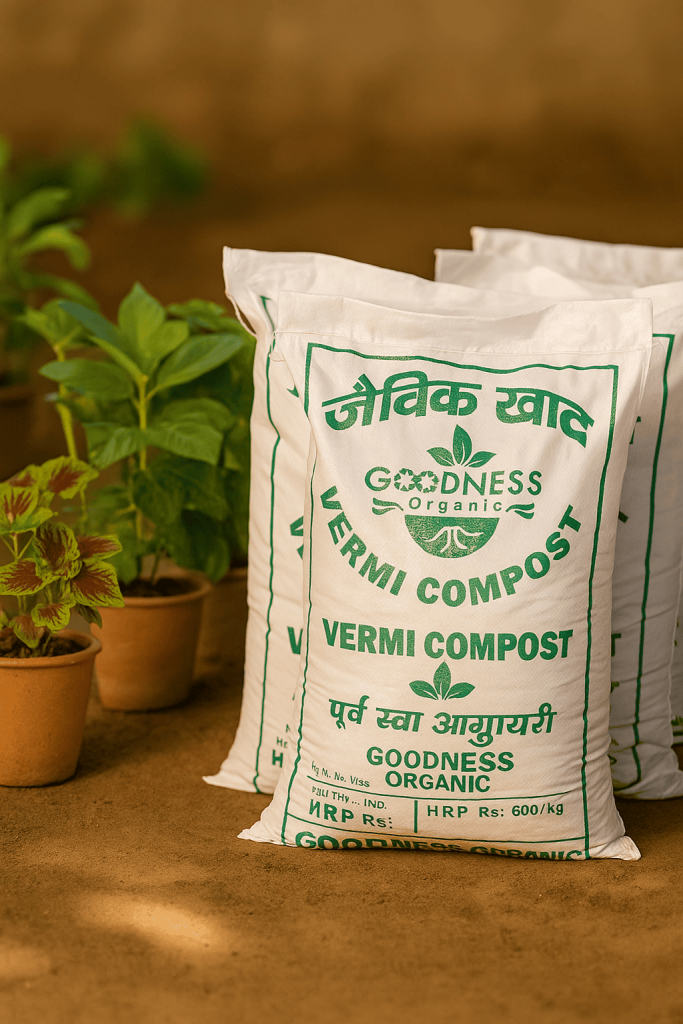
The debate between organic manure and synthetic fertilizers/ Vermicompost Fertilizer vs Chemical Fertilizer has long existed among Indian farmers and gardeners. Synthetic (chemical) fertilizers offer quick nutrient supply — but often at the cost of long-term soil health, environmental harm, and reduced sustainability. On the other hand, organic options like vermicompost provide gradual nourishment, soil improvement, and sustainable yields.
In this article, we compare vermicompost and chemical fertilizers across multiple dimensions — soil health, plant growth, environmental impact, economics, and long-term yield — to help gardeners and farmers make an informed choice.
What Are Chemical Fertilizers — Pros and Cons
Pros:
- Immediate availability of nutrients (N, P, K) — leads to visible plant growth quickly
- Easy to apply and widely available across India
- Cheap per kg (especially subsidized fertilizers for farmers)
Cons:
- Do not improve soil structure or organic matter
- Kill beneficial microbes and reduce soil biodiversity over time
- Cause salt accumulation, soil acidity/alkalinity imbalance
- Require repeated application — make soil dependent on external inputs
Thus, while chemical fertilizers offer short-term boost, they degrade long-term soil health, reduce fertility, and increase dependency on synthetic inputs.
What Is Vermicompost and Why It’s a Natural Alternative
Vermicompost is produced through a natural process involving earthworms decomposing cow dung or organic farm waste into “worm castings” — nutrient-rich humus filled with macronutrients (NPK), micronutrients, beneficial microbes, and growth-promoting compounds.
Vermicompost serves as both a soil conditioner and fertilizer, improving soil structure, enhancing moisture retention, boosting microbial activity, and gradually supplying nutrients — all while being 100% natural and non-toxic.
Soil Health — Short-Term Gains vs Long-Term Sustainability
Chemical fertilizers act quickly but often harm soil ecology. With repeated use:
- Soil loses organic matter
- Microbial life reduces dramatically
- Soil becomes compact, less fertile, prone to erosion
- Water retention worsens
Vermicompost, by contrast:
- Build up soil humus
- Introduce beneficial microorganisms
- Improve aeration and moisture retention
- Maintain nutrient cycles naturally
For sustainable soil health, vermicompost wins hands down.
Crop Yield, Plant Health & Long-Term Productivity
Chemical fertilizers often cause rapid vegetative growth, but over time:
- Plant immunity weakens — more pests & diseases
- Yield quality declines (taste, nutritional content)
- Soil fertility falls — need for more fertilizers increases
With vermicompost:
- Plants develop stronger root systems
- Produce healthier leaves, fruits, vegetables
- Show greater resistance to stress, heat, drought
- Soil fertility improves — less dependency on fertilizers over time
Farmers using vermicompost for multiple seasons often find that soil recovers fertility and yields become stable without overuse of chemicals.
Environmental Impact & Sustainability – Vermicompost Fertilizer vs Chemical Fertilizers
Chemical fertilizers contribute to environmental pollution — soil degradation, water contamination (runoff), nitrate leaching, and greenhouse gas emissions from manufacturing.
Vermicompost offers a green alternative:
- Recycles waste (cow dung, crop residue, organic waste) — reduces landfill burden and pollution
- Enhances soil carbon sequestration — humus traps carbon long-term
- Reduces reliance on synthetic fertilizers — lowers chemical runoff and environmental toxicity
For environmentally-conscious gardeners and farmers, vermicompost is clearly the sustainable choice.
Economic Considerations — Cost vs Long-Term Value
While chemical fertilizers may be cheap upfront (especially with government subsidies), the long-term cost is hidden — degraded soil, crop loss, increased fertilizer dependency, and environmental damage.
Vermicompost, if produced or sourced properly, offers long-term value:
- Improves yield quality and reduces needs for repeated fertilization
- Saves cost on soil amendments and chemical inputs
- Enhances soil fertility, reducing long-term expenditure
Even if the price per kg is a bit higher, the overall return on yield quality and soil health justifies the investment.
When It Makes Sense to Use Chemical Fertilizers — And When to Avoid Them
While vermicompost is ideal overall, there are some situations where chemical fertilizers might be used — but carefully:
- When soil urgently needs a rapid nutrient boost (e.g. in early growth phases)
- For large-scale crops where balanced nutrient supply is critical
- But it’s best used as a complement to — not replacement of — organic compost
For long-term soil health and sustainable farming, keeping chemical fertilizers minimal and relying mostly on organic compost is optimal.
Vermicompost Fertilizer Is the Future of Farming in India
In India’s diverse agricultural and gardening context — from small balcony gardens to large farms — vermicompost fertilizer stands out as the most balanced, sustainable, and eco-friendly fertilizer option. It enhances soil health, ensures long-term productivity, supports environmental goals, and offers lasting value for both small gardeners and large farmers.
Switching from chemical fertilizers to vermicompost is a step toward regenerative agriculture — one that benefits soil, plants, farmers, and the planet.